

Dog stair wedges: how many do you need?
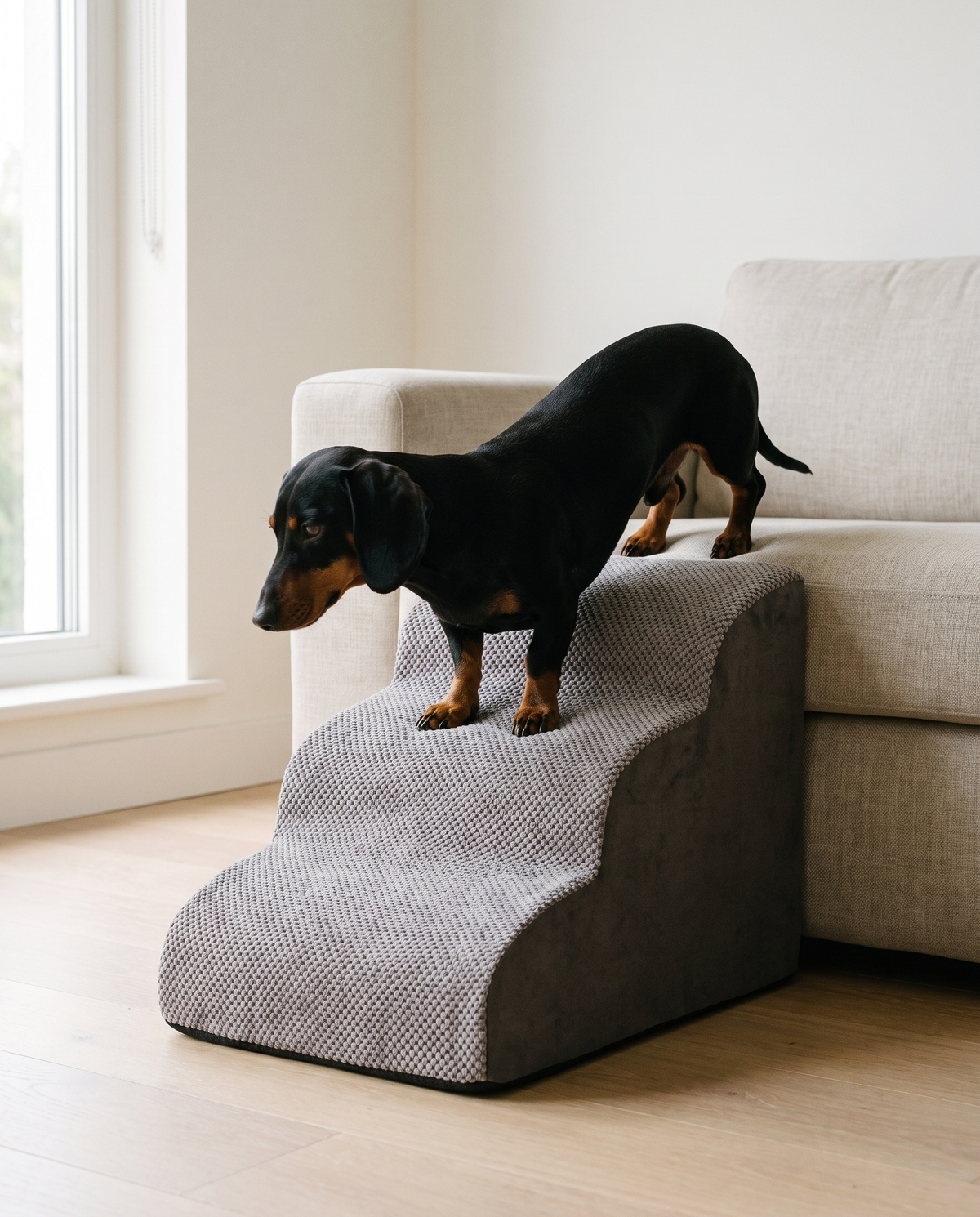
A stair wedge turns the drop between two steps into a short slope. It is a simple idea, and it fails in exactly one way: people buy too few.
This is the arithmetic, before you buy anything.
Count the steps, not the treads
Here is the rule, and it is not obvious:
A wedge bridges the rise between two levels, so it sits on the lower one.
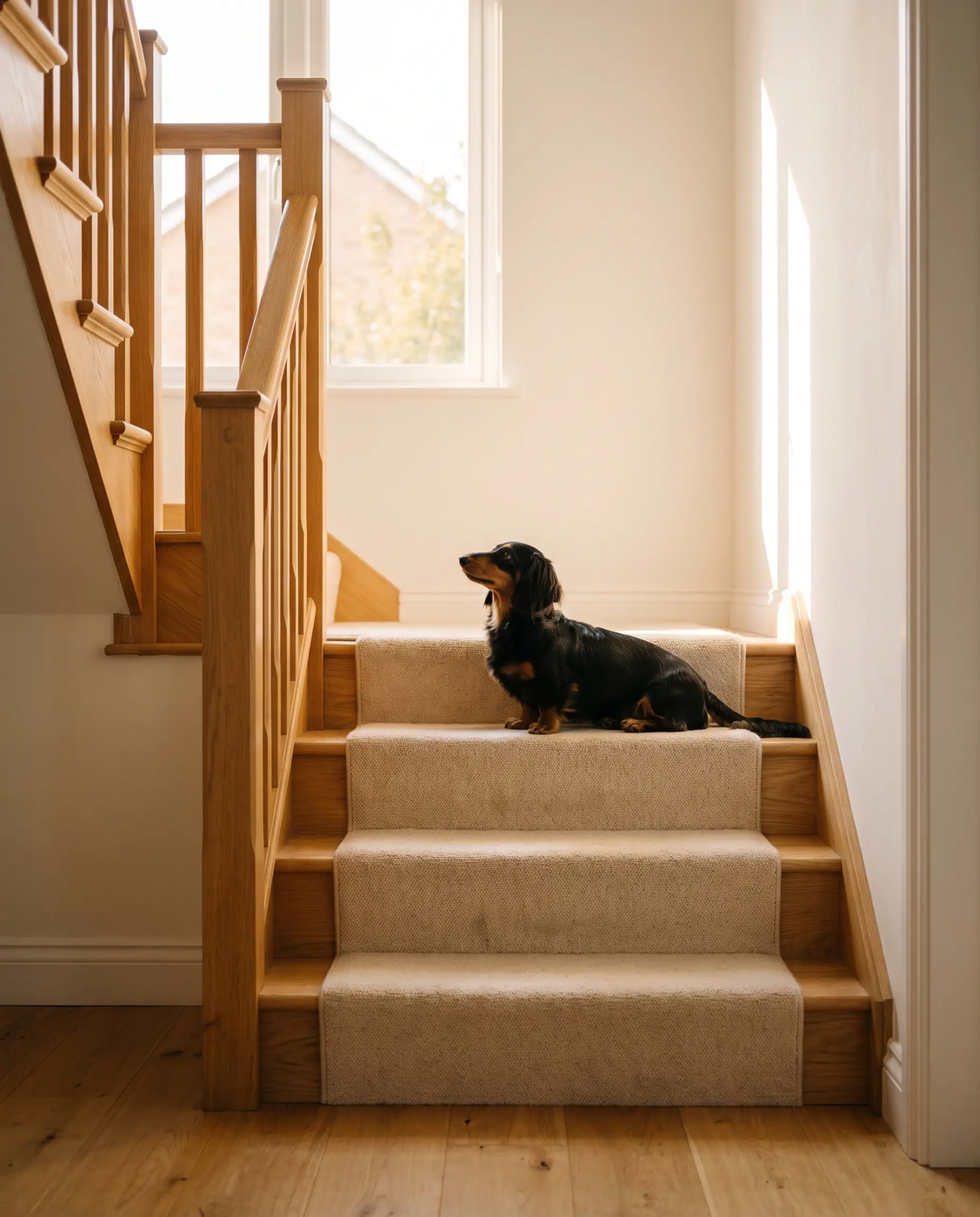
The wedge on your floor lifts your dachshund onto step one. The wedge on step one lifts it onto step two. And so on up the flight. Which means the top step carries nothing - there is nothing above it left to reach.
So the count is: one wedge on the floor, plus one on every step except the top. That comes to exactly the number of steps in the flight.
| Steps in the flight | Wedges needed | Sets of six |
|---|---|---|
| 3 | 3 | 1 |
| 4 | 4 | 1 |
| 6 | 6 | 1, exactly |
| 8 | 8 | 2 |
| 10 | 10 | 2 |
| 12 | 12 | 2, exactly |
| 14 | 14 | 3 |
Go and count your stairs now. Most people are surprised.
The part nobody tells you before you buy
A typical American staircase to a second floor is thirteen or fourteen steps. That is three sets.
Not one. Three.
One set covers a short flight - a split level, a few steps down to a sunken living room, a porch. It does not cover a full flight, and a page that lets you believe otherwise is doing you no favours when the box arrives.
And you cannot do half a staircase. A run with a gap in it is worse than no run at all, because the gap is exactly where your dachshund jumps, and now it is jumping from a height it has been walked up to. Cover the whole flight, or use a stair gate on that flight instead.
Will they fit your stairs?
Two measurements, one minute.
- The rise. The vertical face of one step, floor to the top of the next. Ours fit 5 to 7.5 inches.
- The tread. The flat part you stand on, front edge to the riser behind. Ours fit 9.8 to 12 inches.
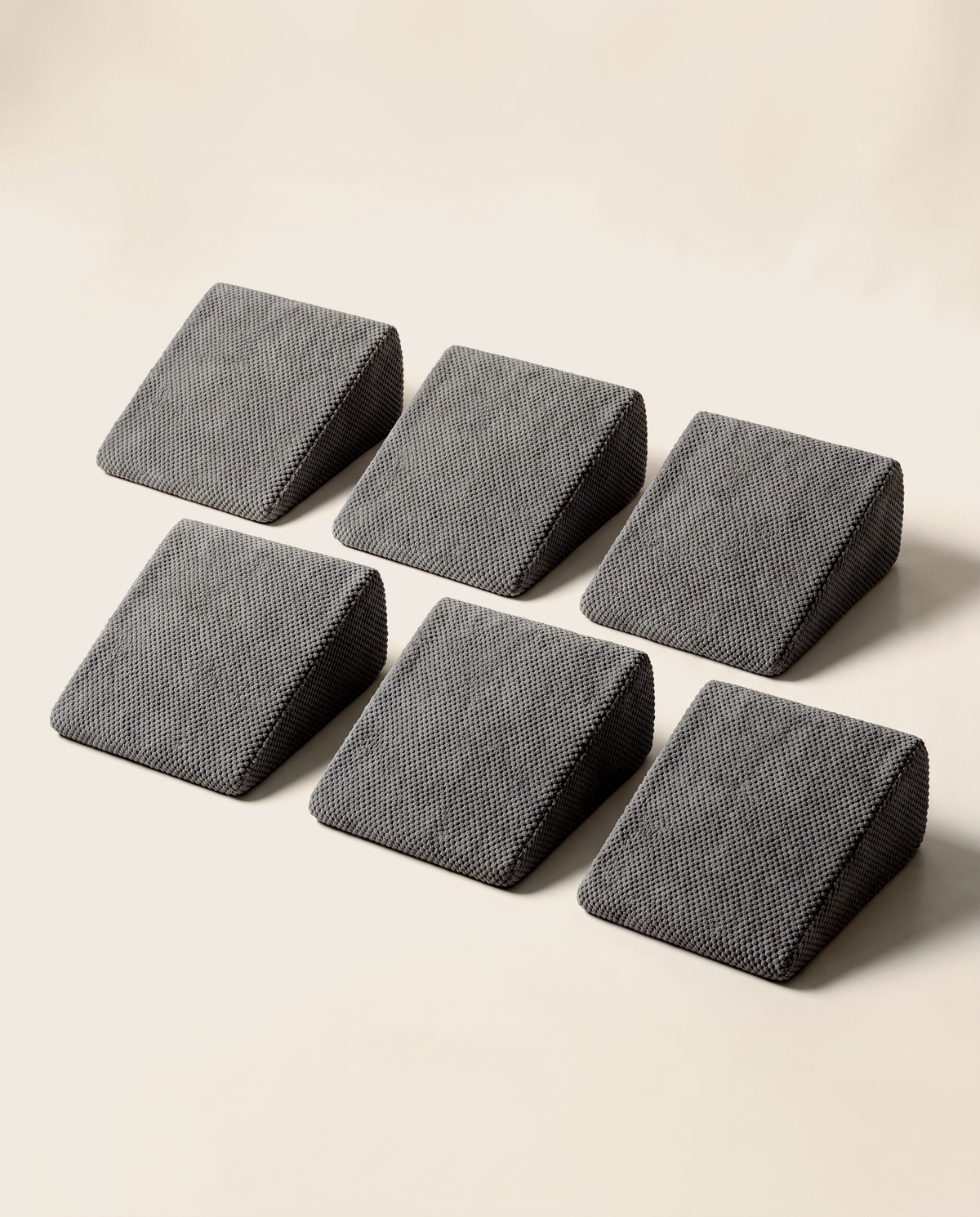
Each wedge is 13.8 inches wide, 9.8 inches deep and 5.1 inches at the thick end.
Measure one step in the middle of the flight, not the bottom one. Bottom steps are often a different size.
If your rise is taller than 7.5 inches, wedges are the wrong tool. A taller rise needs a different solution, and forcing the wrong one produces a slope steep enough to be a slide.
Can people still use the stairs?
This is the question that stops most people buying, and the answer is yes, as long as you install them correctly.
The run goes to one side of the flight, flush against the wall. Each wedge is 13.8 inches wide on a staircase that is usually around 36. That leaves a clear walking strip of roughly two feet on the other side, the full height of the flight. The floor unit sits on the same side so the run is continuous.
Never centre them. A centred run blocks the staircase for people and leaves a useless sliver on each side.
Which way up
The thick rounded end faces up the flight, pressed flat against the riser above it. The slope then descends toward the front of that step, ending in a thin edge.
That way the slope runs the direction your dachshund walks, in both directions. Rotated a quarter turn, or sloping toward the wall, it does nothing.
Each wedge sits with its back edge flat against the riser and fills the depth of its tread. No bare tread behind it, nothing floating mid-step, nothing overhanging the front edge.
Do they stay put?
Each wedge has an anti-slip dotted base and two hook-and-loop strips that fix it to the tread. It stays where you put it.
One thing worth saying about stairs
Wedges exist to take out the jarring drop between steps. They do not exist because stairs are bad for dachshunds.
In the largest US study of the breed, regular stair use was among the factors associated with lower risk of owner-reported disc disease, not higher. Blocking the staircase is not the obvious win it sounds like. The whole argument is here: stairs are not the enemy.
No wedge, ramp, bed or harness prevents, treats or reduces disc disease. What a wedge changes is the height of the drop between two steps, on the staircase your dachshund is already using.
Count your steps, then see the wedges
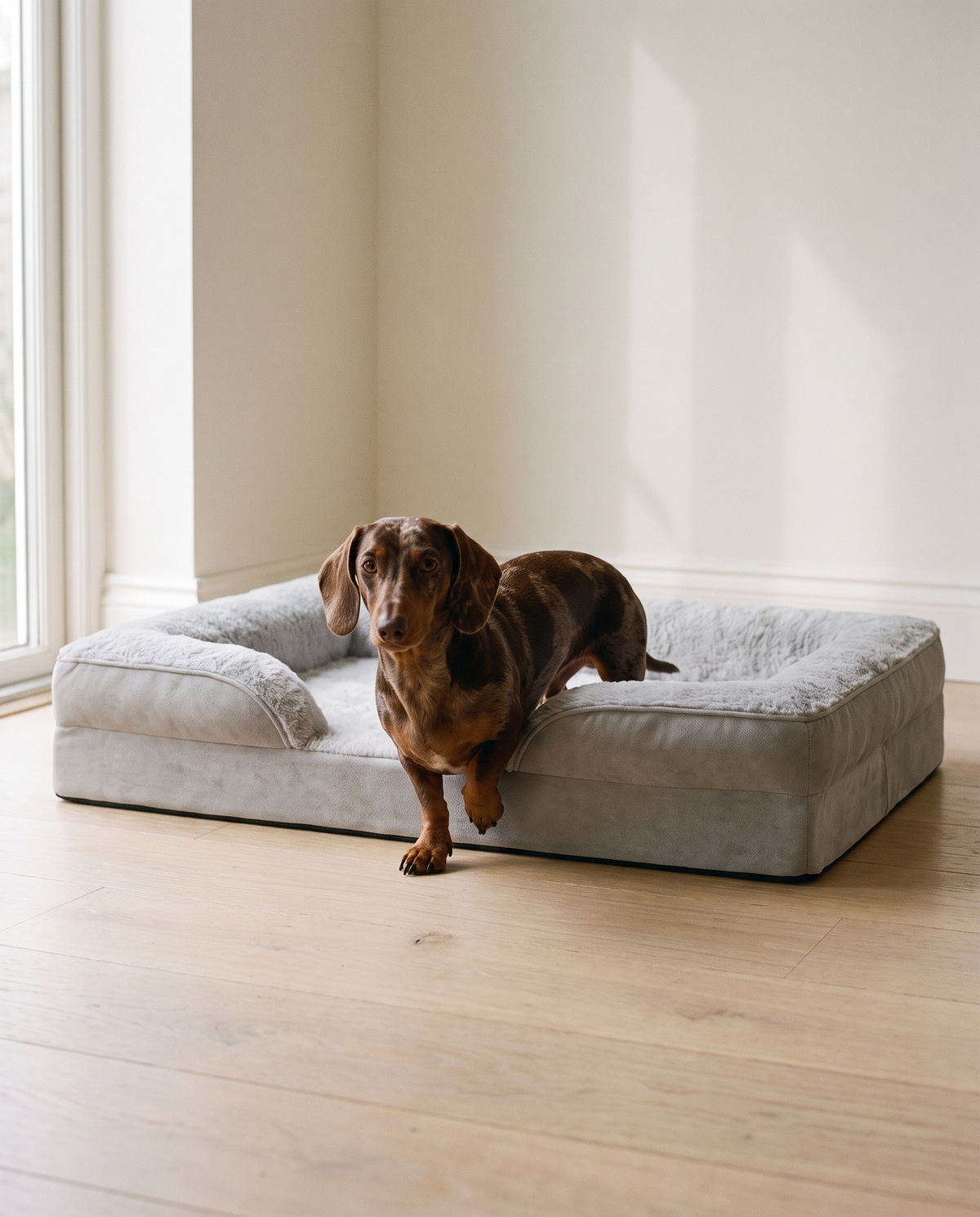
The same measuring problem shows up one room over: what size bed a dachshund actually needs, and why a listed bed size is not the surface it sleeps on.