
How to choose a harness for a dachshund
Ask ten dachshund owners about harnesses and you will hear the same sentence in ten different ways: the neck fits or the chest fits, never both.
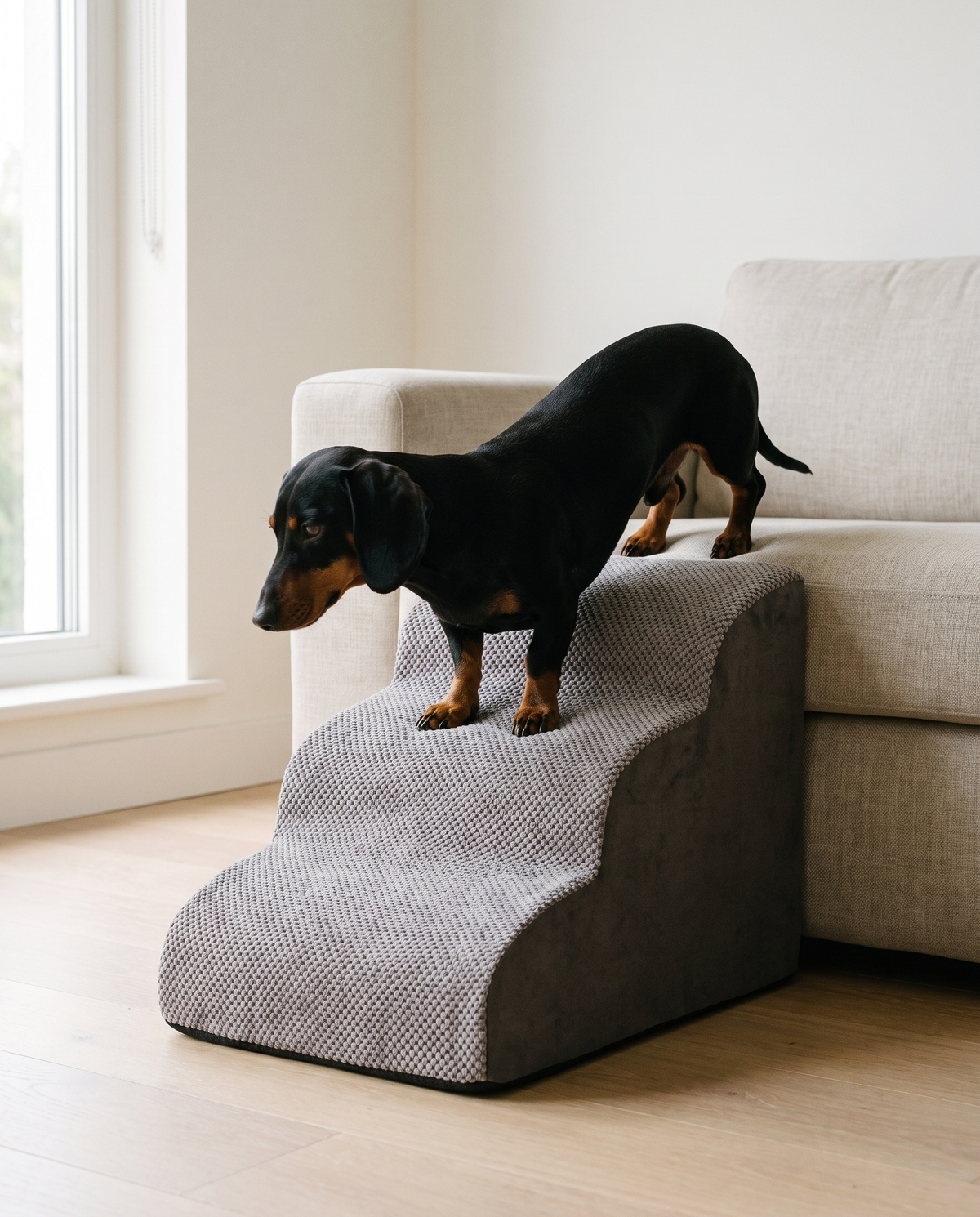
Sorting out the rest of the house as well? Ramp or stairs for a dachshund does the same job for furniture.
That is not bad luck and it is not your dachshund. It is arithmetic. A dachshund is a deep chest on a narrow neck and short legs, and almost every harness on the shelf is cut on a small-dog template, where the neck and the chest are close to the same size. Put that template on a dachshund and one of the two ends up wrong.
This guide is how to get it right, and it works for any harness, not only ours.
Weight does not decide the size
Most size charts open with weight, and weight is the least useful number you have.
Two dachshunds at the same weight can be built completely differently: a compact eleven-pound mini and a long, deep-chested eleven-pound tweenie need different harnesses. The weight bands on every chart overlap for exactly this reason, so weight gets you into the right neighbourhood and then stops being useful.
The tape decides. Weight is only where you start.
The two measurements that actually decide it
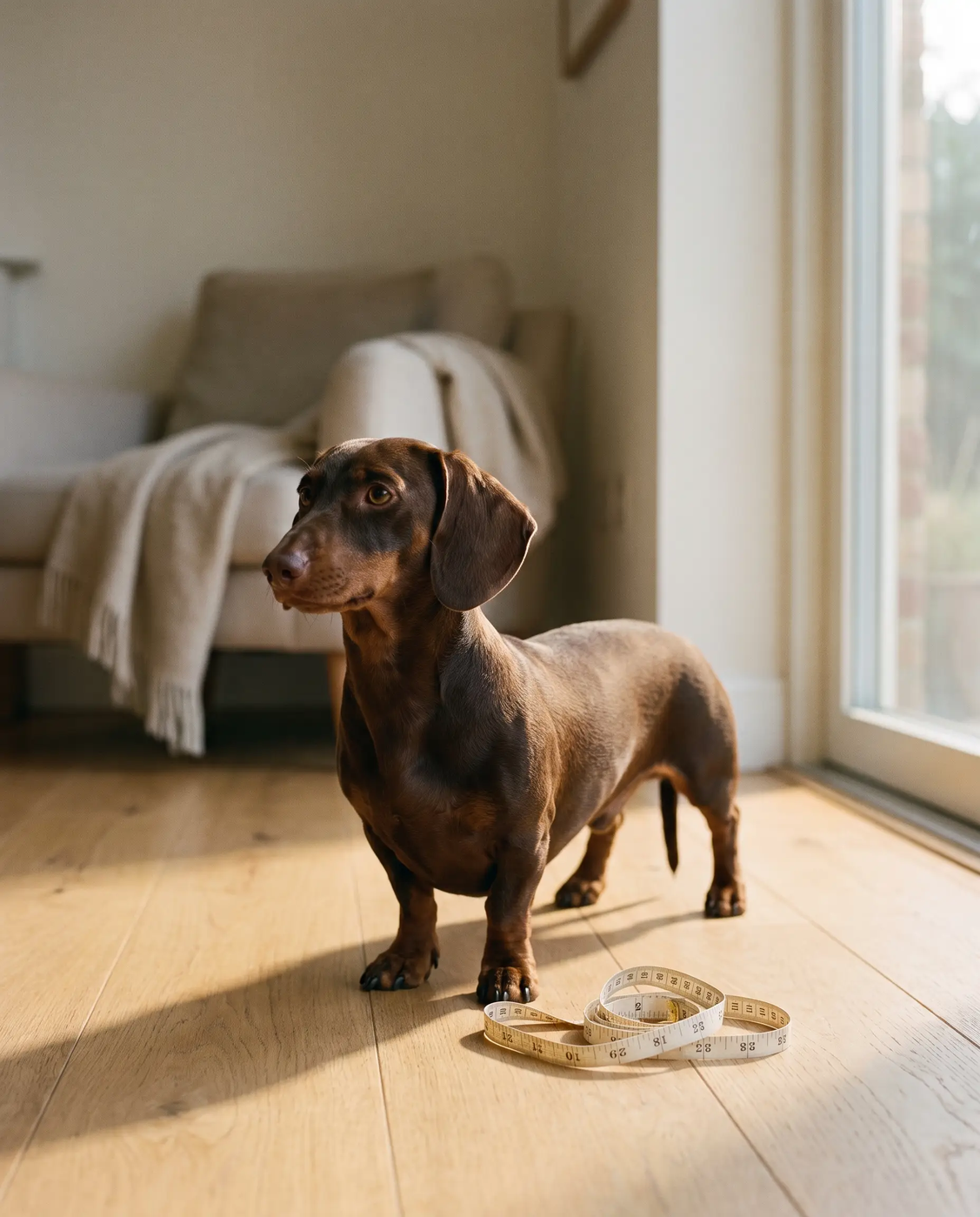
Use a soft tape measure, with your dachshund standing, not sitting.
1. The chest. Wrap the tape around the deepest part of the chest, just behind the front legs. Snug against the coat, not pulled tight. This is the number that chooses the size.
2. The neck. Wrap it around the base of the neck, where a collar sits, not up near the head. This confirms the size the chest chose.
No tape measure in the house? Use a piece of string, mark where the ends meet, then hold the string against a ruler. It is exactly as accurate.
If you land between two sizes
You probably will. The overlap is structural in this breed.
Take the size where your measurement sits nearer the middle of its range, rather than at the edge. A measurement at the very top of a size leaves you nothing to adjust as the coat thickens in winter; a measurement at the very bottom leaves you tightening the straps to their limit on day one.
What you should not do is the thing the category has trained people into: buying two sizes on purpose and returning one.
The five failures that only show up after a week
A harness can pass the tape measure and still be wrong. These are the five things owners report once the newness wears off, and every one of them is worth checking before you buy.
1. The straps creep. Smooth webbing slides through a smooth adjuster. If a harness needs re-tightening every single day, it is not fitted, it is being held. Look for textured webbing or locking adjusters.
2. It rubs where the leg meets the body. Short-coated dachshunds have no fur buffer there, and a strap that migrates into the armpit takes the skin with it. Look for soft lining where the webbing crosses the body, and for geometry that keeps the strap from wandering forward.
3. The chest strap rides up onto the throat. This is the exact failure a harness is supposed to solve. If the front of the harness sits high and the dog pulls, the strap climbs. A Y-front, which sits on the sternum rather than across the windpipe, is the shape that answers it.
4. A front ring drags on the ground. Dachshund legs are short. A leash ring mounted low on the chest catches the floor, tangles behind a front leg, and twists the harness under load. If a harness has a front ring, it needs to sit high.
5. Backing out. The mechanism is specific and worth understanding: when the girth strap sits too far forward, close behind the front legs, a dog that plants and reverses can pull its shoulders and then its head straight out. The girth strap belongs well behind the elbows, with the neck snugged separately. No harness is escape-proof, and anyone who tells you otherwise is guessing about your dachshund. What geometry does is make it much harder.
What to check the day it arrives
- Two fingers. You should be able to slide two fingers flat under the girth strap and under the neck opening. One finger is too tight; a whole hand is too loose.
- Where the girth sits. Behind the elbows, not tucked up against them.
- Where the chest piece sits. On the breastbone, not on the windpipe.
- Walk ten minutes, then look again. Most fit problems appear on the second look, not the first.
What a harness does, and what it does not
This is the part most buying guides skip, so here it is plainly.
No harness prevents, treats or reduces intervertebral disc disease. A harness is not a medical device and nobody has shown that one changes whether a dachshund develops a disc problem.
What a harness changes is where the force goes on a walk. A collar concentrates the whole pull on the narrowest part of the dog. A Y-front spreads it across the chest and sternum instead. A board-certified veterinary neurologist answering dachshund owners on Dodgerslist gives the rule in one line: walk on a harness, no neck leads. Keep the collar for tags.
That is a real and worthwhile difference. It is also a smaller claim than the one the category usually makes, and we would rather you buy on the true one.
The trade-off we will admit
Here is the part you will not read on a competitor's page.
Researchers have put dogs on treadmills and measured what harnesses do to the front legs. Every harness type they tested changed the stride. And the Y-front shape reduced shoulder extension slightly more than a simple chest strap did, by about 2.6 degrees at a walk and 4.4 at a trot (Lafuente, Provis and Schmalz, Veterinary Record, 2019). A later review found the same direction across harness types. Nobody has shown that a few degrees matters clinically, and nobody has shown that it does not.
So every piece of walking gear trades something. We chose the Y-front for what it does to the neck, and we think that is the right trade for a dog built like this one.
What we will not tell you is that our harness is "non-restrictive" or offers "full freedom of movement." Those phrases are printed on a great deal of packaging in this category, and against direct measurement they are not true of any harness, ours included.
Where ours fits
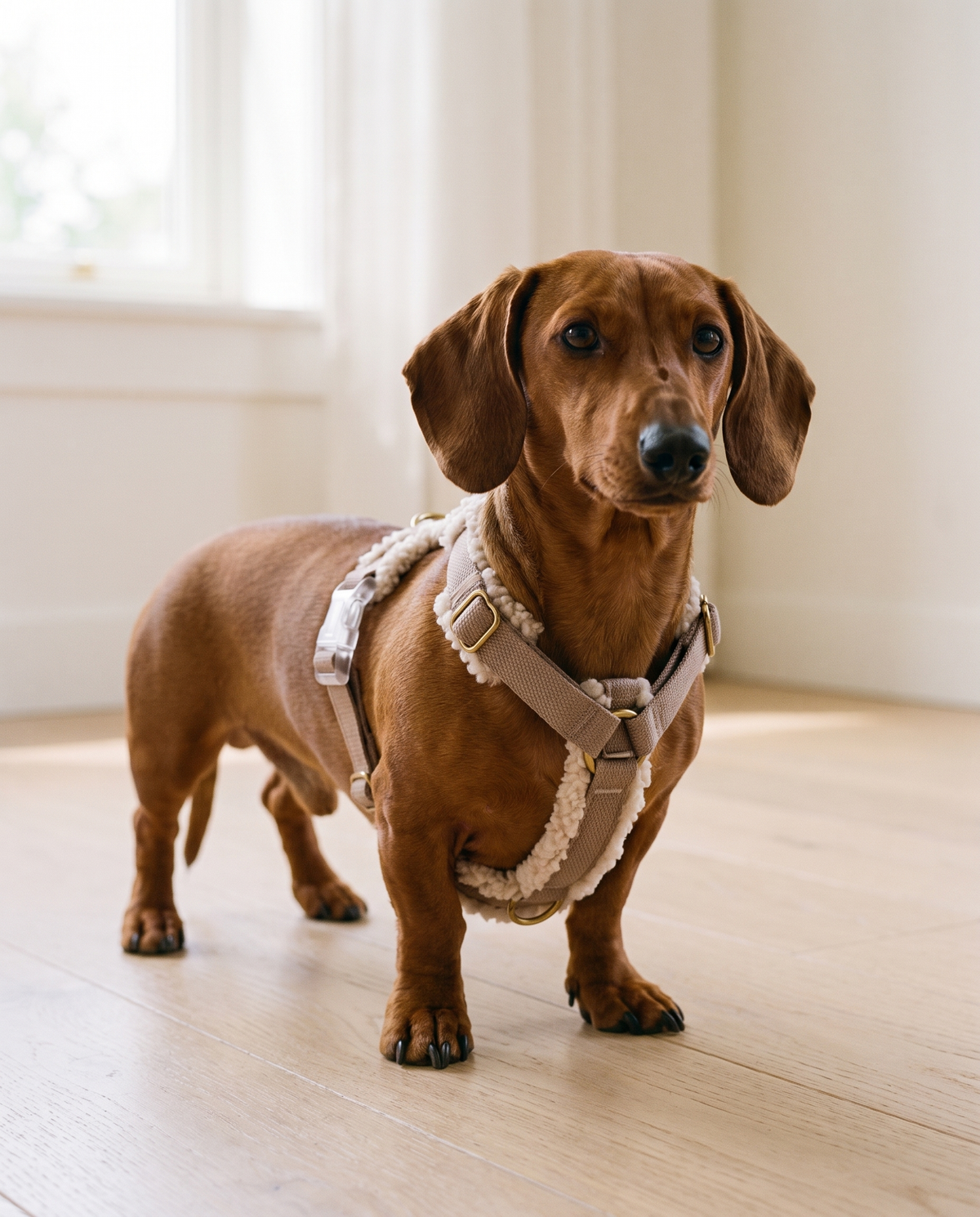
The Doxie Harness is a Y-front, sold in four dachshund sizes: XS Mini, S Tweenie, M Standard and L Large. Each is named for the dachshund it fits, and a tweenie is not a mini.
The webbing is sherpa-lined where it crosses the body, and the leash clips at the back ring on the withers. It is $45, and the size chart, the measuring method above and the between-sizes rule are all on the harness size guide.
If you use everything in this guide and choose a different harness, that is a fine outcome. A dachshund in a harness that fits is the point.